This blog now at www.tonyj2japan.wordpress.com

My photo
Hazelbrook, Blue Mountains, NSW, Australia
A world Cup football game between Australia and Japan in Yokohama was the driver for Tony's first trip to Japan in February 2009. Since then, Veronica and Tony have traveled together, and Tony has been back two more times - an abbreviated holiday in March, 2011 at the time of the catastrophic earthquake and tsunami, and in July/August, 2011.
Showing posts with label Nara. Show all posts

Nara Park - Monday 14th March


Nara Park maps - great use of symbology
Visiting Nara is on many 'must see' lists for Japan, so there probably hundreds of blogs written about this place. I will highlight just a few elements.

Nara was the capital of Japan from 710 to 784 and is considered the cradle of Japanese culture, arts, and crafts. Buddhism first flourished here. The major cultural heritage sites in Nara have been registered on the UNESCO World Heritage list as an irreplaceable part of the cultural heritage of all humanity.

By visiting Nara Park and its many sites on a Monday I was likely to miss some of the usual crowds. I got away early, aiming to be on the sight seeing trail by 9:00am. The guide from the local tourist information centre was great, and the friendly staff had pencilled in a suggested route. Being me, I decided to take in as many of the minor temples and shrines in the precinct as I could rather than head for the 2 or 3 primary tourist destinations.

Tenjin Shrine
Sarusawa-ike Pond and then Gangoji Temple got me in the culture and history mood, then on past the Daijoin Temple and Cultural Hall (closed at this time). Entering the south-west corner of Nara Park I found the Tenjin Shrine, juxtaposed beside a children's playground. Tenjin Shrines are dedicated to the kami of Sugawara Michizane. Again, a lone devotee was making an offering at the shrine.


Ukimodo Hall at Sagi-ike Pond


Winding pathways led to the Saga-ike Pond and the beautiful Ukimodo Hall that in the stillness of the morning seemed to be floating on the glassy lake. Cherry and plum blossom buds hung pregnant, due to burst with colour in the coming days and weeks.


workers at Kasuga Wakamiya Shrine
The cleanliness and order of Japan
finished swept gravel
is wonderful. At the Kasuga Wakamiya Shrine a group of 5 older men and women swept every leave away from the entrance ways and paths. And then I saw their real handiwork - the gravel forecourt stroked artistically with rakes. I did not dare walk on it, if only much beauty could remain forever.


novices at prayer ~ Enomoto Jinja

Having admired the Kasuga Grand Shrine, the mid-morning calm was broken (or is that accentuated) by a low and melodious chant. At enomoto-jinja two young trainee priests (I assume) chanted on the outside landing as a senior priest undertook a ritual inside, around a shrine. The rhythmic chant continued for some minutes, accompanied by the gurgling of water cascading through a small channel nearby. I stood and listened a respectful distance.


Manyou Botanic Garden
Adjacent to the Kasuga Grand Shrine are the Kasuga
Spot the deer


Taishi Shanen Manou Botanic Gardens. While small, the landscaping particularly the water features is beautiful.

A few plum blossoms were out, as were some camellias. Alas, a few days or weeks early for the hundreds of plum and cherry trees to be in bloom - but it can be imagined.


The Great Bell
The Great Bell of Todai-ji is, well, big.
Geez that bell is big

Called "Nara Taro" it was made in the Kamakura-era (1192-1333) and is 3.9 m. high and weighs 26 tons.


A tile for eternity
The Todai-ji Temple was completed in 752. The current building is the second remake of the original and is at two-thirds scale of the original. That still makes it the biggest wooden building in the world! 

I understand that the maintenance of huge buildings like this would cost zillions of Yen, and that the tourist trinkets are important income for these places. I usually limit my trinket purchases, but I was struck by the invitation to purchase a roof tile for 1,000Y.

On the underside of the tile you could inscribe your words for the ages ahead. My words 'for the love and peace in eternity' were drawn from the Todai-ji Temple itself, its re-incarnations over 15 centuries. I finished off my tile with 'for my family' to symbolise that my family travels with me to this spot and everywhere in my heart and soul.


I can't go anywhere without drawing in some emergency management issue, and Nara Park was no different! The 'refuge site' designated the safe place to congegrate following an earthquake, when the greatest dangers will be from fire.

Earthquake Refuge sign ~ understandable using symbology

Shine Road - Sunday 13th March

While my room at the Fujita Hotel might have been on special, food and drink prices reflected the 4 Star rating. On this sort of trip, the thought of paying 10,000Y to eat was not retained long. Off to find an 'izakaya' Japanese style pub.
Shine Road - in under the sign

There are eateries everywhere you go. Choice is not difficult if you use two basic rules. 1. go where Japanese are eating. 2. be willing choose something off a menu you may not understand. Now whether Shine Road was an izakaya or not, it was cheap, pleasant, quick and good food, and had a number of locals coming and going. The menu comprised seemingly endless varieties of meat and vegetable, as long as you wanted it fried and put on a stick. Very nice, especially the sweet potato.

After the long bike ride, a good Japanese beer was needed, so I ordered a Kirin, not in a glass but in a bottle - assuming it to be 360ml or so. Aw no, a bloody big bottle. Had to be polite and knock it off quick time.

Which way is Nara again? - Sunday 13th March

The walk to Hotel Fujita from JR Nara Station was only 500m, along Sanjo-dori which is the main pedestrian route to Nara Park. Central Nara was surprisingly low-rise, with myriads of lanes accessing small shopping complexes.

The Hotel offered bikes for hire, the comfortable single-gear jobs, with a basket on the front. Extremely practical for holding a back pack with jumper, camera and water. I really enjoy being able to get out on a bike, even for a short time, to explore the back lanes or to enjoy observing locals being locals. I have had the pleasure of doing this in San Francisco, Kyoto and now Nara.

families urging on a home run
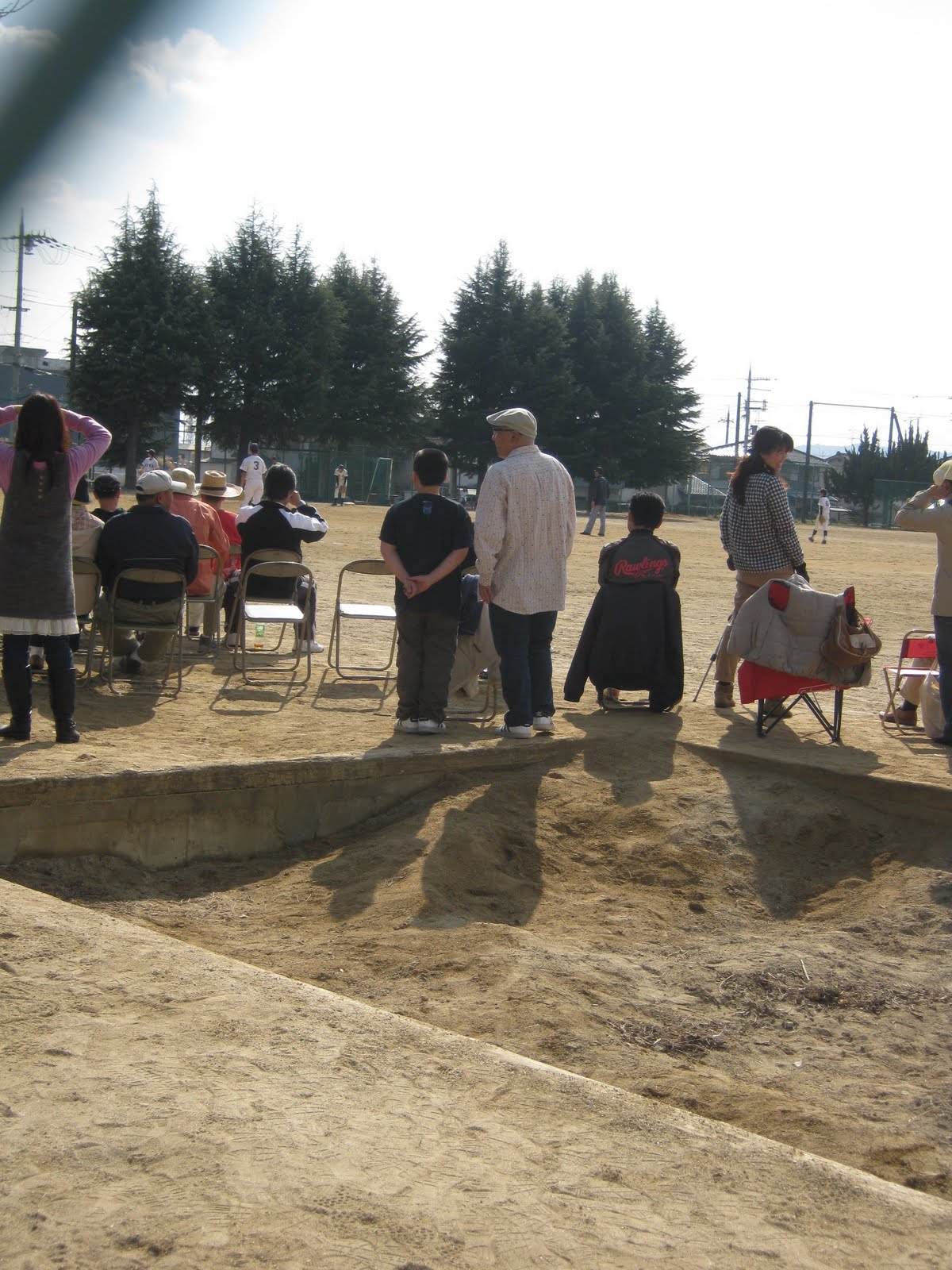
Since Nara Park and its numerous cultural sites was on the plan for tomorrow, I headed in the opposite direction westwards along Sanjo-dori before turning south along a canal-side bicycle road. Sunday afternoons for 20 years have been occupied by playing soccer, or watching one of my 3 kids play. Baseball is the major sport in Japan and it was not long before I passed by a game in progress, being watched by a group of reserved but attentive families.  Along with some 5 other people I leaned up against the chain-wire fence, hoping to witness the game-winning home run. Alas, after some minutes, no-one had connected with a pitch, so I moved on.

my bike at Daian-ji Temple
Found the main Nara Fire Station and looked around like a kid in a candy store. I need to learn Japanese and then have the gumption to knock on the office door! Another trip maybe. Lanes criss-crossing crop fields got me to the Daian-ji Temple.

Such places are very spiritual. In the time I was there, a man sat almost motionless on a seat in what seemed to be quiet contemplation. I felt uneasy taking his photo, even from a distance, as if I would disturb his space.

a beautiful avenue

As I write this blog some weeks after being in Nara, I have yet to actually work out where my bike odyssey took me. I did pass by this fantastic shrine which had an covered avenue of trees leading to it that was spectacular. A 'discovery' like this of the beaten track provides an enduring memory of the bike ride. At this place, a lone old man - maybe in his 80's - offered short simple prayers before engaging me with a smile. Then I was the only person at this place, that was established some 800 years ago.


Farmer resting in his field


Later on, I observed a lone farmer resting in his field. I wondered if his thoughts were like mine - this is the sort of landscape and rural dweller that have been consumed by Friday's tsunami.


By this time I had the bug for traveling along paths and tracks across the rural outskirts of Nara - or atleast I thought it was Nara. At a railway crossing I had to wait with 2 motor scooter riders as a single carriage train rolled by. I could see a station up the line to the left, and multi-storey buildings to my right in the distance that I took to be Nara. So turn right I did do.

Obitoke-dera Temple
Through kilometres of laneways, past at least 4 Volunteer Fire Corps sheds, and a few more rail crossings, I turn up at the Obitoke-dera Temple. By this time is was nearly 4:30pm, and there was only 4 Japanese folk and myself at the temple. I was keen to have a look around, and paid my entrance fee - not knowing that I was now entitled to the guided tour. At this point, one of the Buddhist priests greets me and led on the tour. A small amount of information was available in English, and I had read already on my tourist guide that this temple is renowned as a place where 5-month pregnant women come to pray for easy delivery of their child. This enabled me and my priest guide to communicate by gestures and recognition of symbols, not language. It was very nice. The priest insisted on me having the Temple guide, in Japanese, to take home. These experiences might seem trivial, but this was the intent of exploring these sites of rich importance and significance to many Japanese people. This makes the country special.

After the spiritual interlude, back on the bike, and in hindsight another wrong turn! Finally I got near enough to a main road to read the signs. Only 9kms to Nara - in the opposite direction to the way I was going! I need new batteries in the human GPS.

Atleast the ride in was flat, getting back to Hotel Fujita just on dusk which was handy as I did not have any lights. A great 3 hours!

Give up on the hostels

I have to accept it. A mix of being 50+, alone, and not a conversationalist tends to make me stick out like dogs balls in the hostel setting.

K's House Tokyo, Kuramae
At K's House Kuramae (Tokyo) the hostel was very nice. The foyer and lounge area however was quite small, and filled with young, well traveled and connected people - eying each other off as well as providing recommendations about places to go to.

So where does a grey haired guy, old enough to be father of most of the travellers, sit in a room crowded with youngens? I felt like a Toolie at Surfers Paradise. And anyway, my hips don't allow me to squat on the floor like a yogi.

I know, off to my private room! Very nice in the scheme of hostels, but really, really small, with a small TV. Atleast it was not a bunk room. And the toilet is shared. This cost 3,900Y which was a fair hostel price (about $60A).

But then in Nara I got a room at the Fujita Hotel - probably 4 stars - for 5,000Y (about $80A), the room had a big double bed, desk, lounge, and its own shower and toilet.This hotel had its own bar and restaurant as well. Too expensive for me to use though.

Fujita Hotel, Sanjo-dori, Nara
The trick with getting this hotel was to go to the information desk at the railway station. They had a list of hotels with rooms available for that night - all on special, and in any price range you wanted.

Most towns have numerous accommodation places, so its worth the risk not making a pre-booking and seeking out the last minute bargain.